Clinical Tools

We have developed a collection of practical resources to support therapists in their clinical work. These tools are designed to enhance understanding, guide case conceptualisation, and support therapeutic decision-making. To access any resource, simply enter your name and email address. The tool will be sent directly to your inbox.

Please note: Occasionally, emails may be filtered into your SPAM or Promotions folder depending on your provider.

Polyvagal Theory Tools

Where have I Journeyed today?

“Where have I Journeyed Today?” helps therapists, educators, and caregivers recognize shifts in their autonomic nervous system, enhancing self-awareness. This reflective tool provides an opportunity to review your ANS ‘A’ States before commencing clinical sessions or work interactions. It helps you arrive with increased self-awareness and readiness to engage effectively.

Subscribe below to receive ‘Where have I Journeyed Today?’

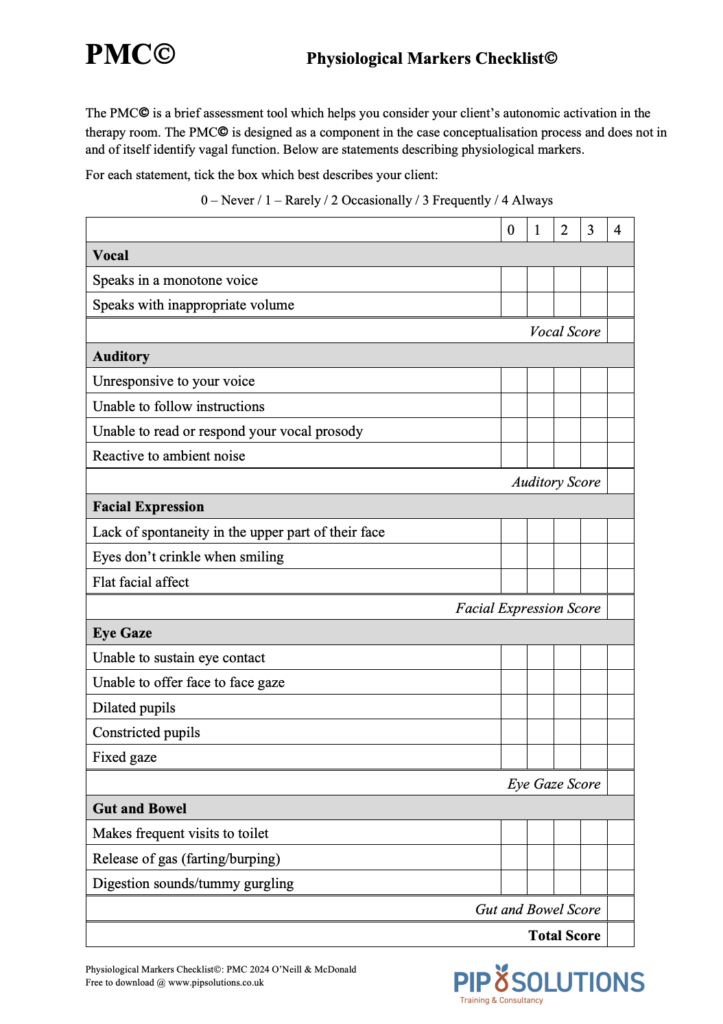
Physiological Markers Checklist

The PMC© is a brief assessment tool which helps you consider your client’s autonomic activation in the therapy room. The PMC© encourages therapists to have focused awareness on clients’ unconscious non-verbal communication about their internal worlds. When utilised throughout the therapeutic process, it serves as an additional measure to consider the client’s development of a neuroception of safety.

Subscribe below to receive your Physiological Markers Checklist©

ANS ‘A’ States: Quick Reference Guide

Through the lens of The Polyvagal Theory, understanding the Autonomic Nervous System (ANS) is essential for supporting children in managing stress, regulation, and connection. PIP Solutions has designed ANS “A” States as a quick reference guide to provide a concise and structured framework to help practitioners identify autonomic states and respond effectively within therapy sessions.

Subscribe below to receive your ANS ‘A’ States: Quick Reference Guide

Child Social Engagement Capacity Questionnaire

The Child Social Engagement Capacity Questionnaire© (CSECQ©) supports therapists to begin the process of formulating an understanding of their client’s autonomic responses to the environment. This assists the therapist with Case Conceptualisation in the context of three important concepts: 1) Goal Setting, 2) Adult Mentalisation, and 3) Psychoeducational Needs.

Subscribe below to receive your Child Social Engagement Capacity Questionnaire